What to look for when choosing a flatbed applicator
Choosing a flatbed applicator is about more than finding a table that fits your largest sign. The right machine should fit your materials, workflow, operators and production needs, both today and in the years ahead.
Dag Eirik Thomassen
04 Sep 2026
Start with what you actually produce
The first question is simple: what kind of work will the machine be used for?
A company producing standard signs and displays has different requirements from a manufacturer working with oversized panels, traffic signs or large-format graphics.
Look at the work that actually moves through your production:
- What are your most common sign and substrate sizes?
- What is the largest format you regularly produce?
- What widths of vinyl, laminate and other media do you use?
- Do you mainly produce individual jobs or repeated production runs?
- What other tasks would you like to perform on the same workstation?
- Are your production needs likely to change or grow?
The goal is not necessarily to buy the largest machine available. It is to choose a working area that makes sense for the way you produce.
Think beyond table size
Dimensions are easy to compare on a specification sheet. How a machine works in everyday production is more important.
A flatbed applicator may become one of the most frequently used workstations in a sign shop, so consider how easily operators can access the table, position materials and control the roller.
Look at details such as:
- Access to the entire work surface
- Visibility during positioning and application
- Ease of roller operation
- Working height and ergonomics
- Storage and media handling
- Cutting and preparation on the table
- How easily the machine can be repositioned when needed
Small differences in design can have a significant impact when the machine is being used every day.
Consider the complete workflow
A flatbed applicator does not have to be useful only when you are applying graphics.
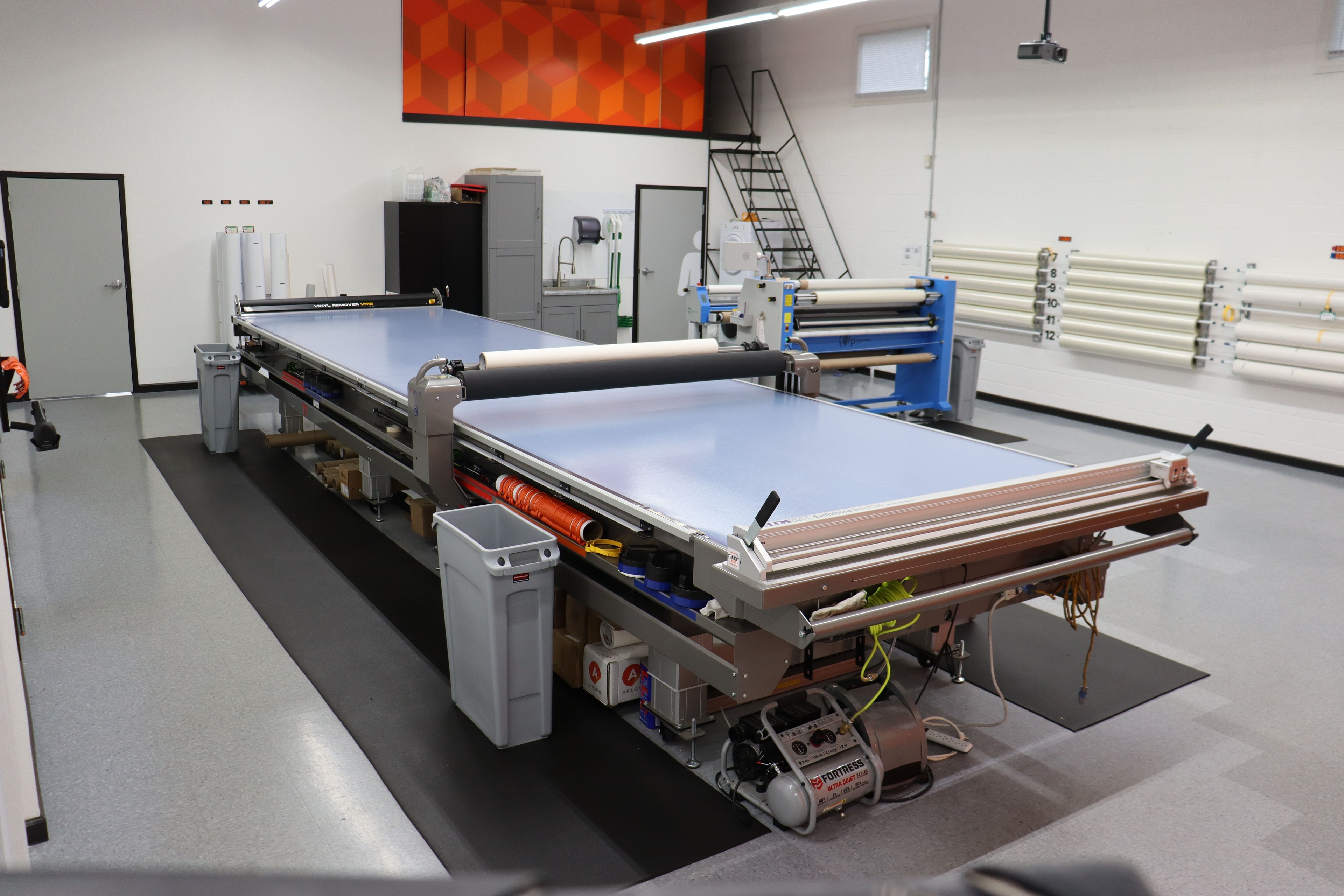
A large, stable work surface can become a central part of the production workflow for mounting, laminating, positioning, cutting, preparation and finishing.
An illuminated glass bed can make alignment and inspection easier, while an integrated cutting mat allows preparation and cutting to take place on the same surface.
The more processes you can bring together at one workstation, the less time operators need to spend moving materials between different areas of production.
Choose for the operator
The people using the machine every day should be part of the decision.
Large graphics and rigid substrates can be difficult to position and handle manually. Good ergonomics, clear visibility and simple controls can make production both easier and more efficient.
Rollover is designed without a fixed overhead beam above the roller, giving the operator unrestricted access to the work surface. The control handles move together with the roller and allow smooth one-hand operation.
For businesses where several people use the same machine, simple and intuitive operation also means less training and a more consistent way of working.
Look at the machine, not just the purchase price
Two flatbed applicators may perform the same basic task while being very different machines to own.
Purchase price is therefore only one part of the decision.
Consider construction quality, maintenance requirements, expected working life, warranty, availability of spare parts and access to support. Also consider the cost of downtime, wasted materials and inefficient production over the lifetime of the machine.
A machine that costs less initially is not necessarily the machine that costs less to own.
Make sure it fits your facility
The machine has to reach its final location before it can start producing.
Check entrances, doors, corridors and other access restrictions before ordering, particularly with larger machines.
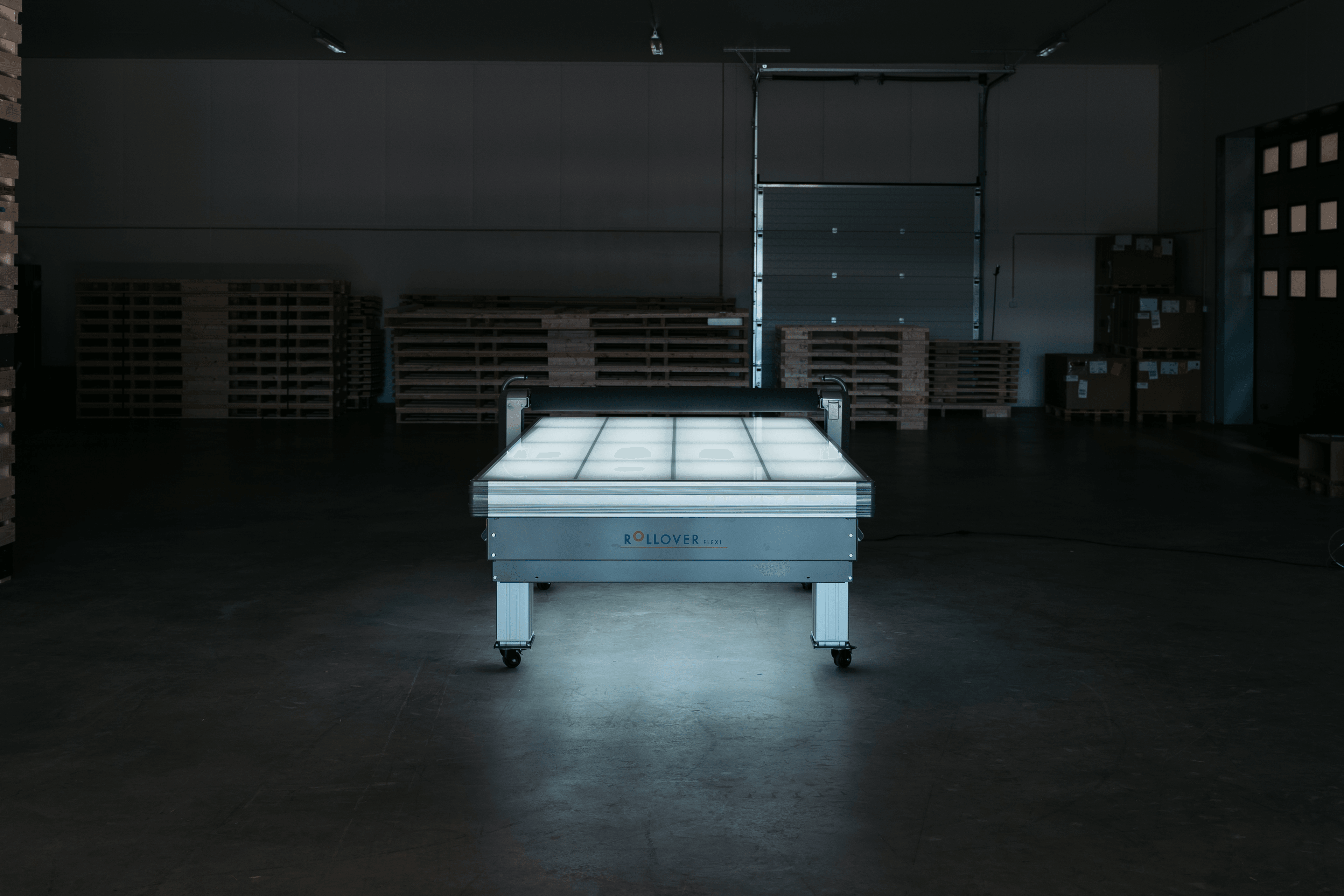
This is one area where the Rollover Flexi can be especially useful. Flexi is delivered fully assembled and ready to work, but can be dismantled into three main sections when access to the production area is restricted.
Also consider the space operators need around the machine and whether you may need to reposition it within the workshop later.
Classic or Flexi?
Rollover offers two product lines built around different production requirements.
Rollover Flexi is available in three practical sizes built around common sign and print formats. It is a strong choice for everyday production where standard working sizes cover most jobs.
Rollover Classic is designed for greater size flexibility and larger production requirements. With a 170 cm (5'7") wide glass bed and configurations ranging from compact working areas to very long production tables, Classic is suited to businesses that need more freedom in choosing their working size.
Both are built around the same Rollover philosophy: simple operation, unrestricted access to the work surface, robust construction and a machine designed for professional daily production.
Choose for the work you will do tomorrow
A flatbed applicator is a long-term production investment.
Your current requirements should determine the starting point, but it is worth considering where your business may be several years from now. Larger jobs, new customers or increased production volumes can change what you need from the machine.
Choosing the right flatbed applicator therefore comes down to more than specifications.
Choose the working area you need. Choose a machine your operators will enjoy using. And choose equipment that can remain a reliable part of your production for years to come.
Ready to improve your production?
Find your nearest Rollover dealer and discover how a premium flatbed applicator can improve quality, efficiency and ease of operation. With local dealers in more than 60 countries, expert advice is never far away.